 IT
IT  EN
EN 
The Voice of the Brand: a practical guide to getting recognised (and remembered), starting with your name and payoff
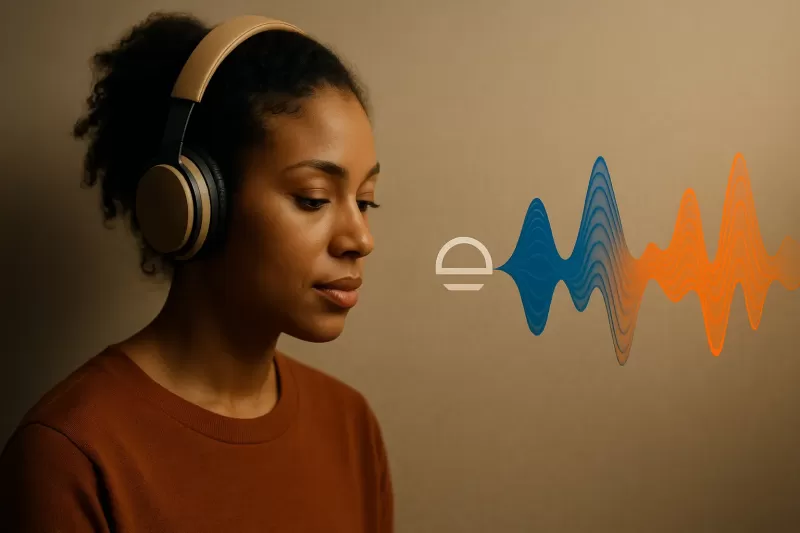
Imagine walking into a crowded room. People are talking, laughing, debating. Some voices get lost in the background hum, while others instantly grab your attention. There's the calm, deep voice that inspires trust, the bright, quick one that transmits energy, the warm, welcoming one that makes you feel immediately at home. You haven't quite grasped what they're saying yet, but you already have a clear perception of who they are.
Well, a brand's voice works exactly like that.
It's not an optional extra; it's not a fancy outfit to wear on special occasions. It's its essence, its stance in the world, its way of breathing. And as verbal designer Chiara Gandolfi acutely noted in a recent article of hers, the first, most powerful clues to this voice are hidden in plain sight: in the name and the payoff.
Those initial fragments of language aren't just labels. They're a handshake, a declaration of intent, the opening chord of a symphony. And if the chord is out of tune, the whole melody will suffer.
In this in-depth guide, we won't just skim the surface. We'll delve deep to understand why a brand's voice isn't a copywriter's whim, but a fundamental strategic asset. We'll analyse winning examples and disastrous missteps, and we'll provide you with a practical compass to find, define, and orchestrate your brand's unique voice.
Let's Be Clear: A Brand's Voice is Inevitable
Before we dive into the "how-tos," let's clarify a crucial point that often causes confusion. Developing a brand voice isn't like deciding whether to open a TikTok channel or invest in Google Ads. Those are tactical choices. Voice, however, isn't a choice: it's an inevitable fact.
Every time your brand communicates – with a social media post, a support email, a product description, or the text on a website button – it's using a voice. Unless you run a business based on sign language in a completely silent environment, you already have a voice.
The real question is: is it the right voice? Is it consistent? Is it a voice that belongs to you, or is it a random, perhaps sloppy and impersonal, echo of past communications?
Ignoring it means letting chance paint your company's portrait. And chance is rarely a good art director. Working on it, however, means taking control of the brush and starting to paint a faithful, intentional, and memorable portrait.
The Big Bang of Verbal Identity: Name and Payoff
If the voice is a symphony, the name and payoff are the first two notes. They must contain the DNA of the entire piece. They are the promise that anticipates the experience.
Let's analyse some examples to understand their strategic power:
Airbnb: Belong Anywhere.
What it doesn't say: "Short-term rental app," "Book holiday homes," "Cheap stays."
What it does say: It offers you an emotion, not a service. It shifts the focus from the transaction (renting a bed) to the transformation (feeling part of a place). The voice is empathetic, global, human. It evokes a primal need for belonging. It's a promise so powerful it justifies an entire market category.
Eataly: Alti Cibi. (High Foods, also a play on words similar to 'alticci' meaning tipsy)
What it doesn't say: "Quality supermarket," "Typical Italian products," "Food and catering."
What it does say: It uses a clever linguistic play (where "Alti Cibi" also playfully suggests being "tipsy" or enjoying a 'high' experience) that combines excellence with conviviality. It ennobles everyday food, elevating it to a cultural experience. The voice is cultured, ironic, proudly Italian. It's a positioning statement aimed at an audience that seeks not just sustenance, but also history and meaning.
Aesop: In Praise of Shadows. (Payoff used in some campaigns, perfectly aligned with the brand)
What it doesn't say: "Luxury cosmetics," "Natural skincare products," "Beauty and wellness."
What it does say: It evokes an entire philosophy. It speaks of slowness, introspection, of a beauty that is not ostentatious but discovered. It's a reference to Jun'ichirō Tanizaki's essay of the same name, which celebrates the Japanese aesthetic of dim light. The voice is sophisticated, poetic, intellectual. It doesn't sell a product, but a ritual, a sensibility.
These payoffs work because they don't describe, they evoke. They don't list features, they suggest values.
Anatomy of a Verbal Short Circuit: The "Grezzo" Case
Now, let's move to the dark side of the coin. The analysis of "Grezzo Raw Chocolate" is a perfect manual on how a brand's voice can fragment and create confusion.

The conflict in play:
The Name:
Grezzo(meaning "raw" or "rough"). The word evokes materiality, simplicity, an almost rustic craftsmanship. It's a straightforward name, "bread-and-butter." It promises a direct, no-frills experience.The Lexicon ("Evolutionary pastry," "Energy of living food"): Here the voice shifts register. It becomes ideological, almost scientific, complex. It targets a niche of conscious consumers, almost adherents of a food philosophy.
Payoff #1:
Raw Chocolate. Here's the first short circuit. After the promise of simplicity from the name and the philosophical elevation of the lexicon, we arrive at a technical, cold, label-like description. It's an aseptic voice, speaking English in an Italian context, and merely describing the "what" without a hint of the "why."Payoff #2:
I dolci più sani del mondo(The healthiest desserts in the world). Here the voice collapses. From the technical, it switches to the naively superlative, almost shouting. It's a hyperbolic promise that, not being immediately and solidly substantiated, risks generating distrust. It abandons the elegance of the "evolutionary" lexicon for a claim that sounds like it came from a TV infomercial.
The Result? A schizophrenic voice. A potential customer is faced with four different "people":
- The simple artisan (
Grezzo). - The food philosopher (
evolutionary pastry). - The lab technician (
Raw Chocolate). - The carnival barker (
the healthiest desserts in the world).
Who am I talking to? Who should I trust? This verbal cacophony creates cognitive dissonance that weakens the brand, even if the product quality might be excellent.
How to Build a Brand Voice: The Practical Guide
Okay, we've understood the strategic importance and the risks. But practically, how do you sculpt a voice that is authentic, consistent, and recognisable? It's not magic; it's method.
Step 1: Brand Archaeology (Digging to Find Out Who You Are)
A voice isn't invented; it's discovered. It must be rooted in the reality of your company. Start with these questions:
Why do we exist? (The Mission, beyond profit)
What is our biggest purpose? (The Vision)
What do we firmly believe in? (Values. And no, "quality" and "professionalism" aren't enough. Be specific. "Curious audacity"? "Irreverent elegance"? "Rigorous simplicity"?)
If our brand were a person, what kind of person would they be? Are they the reliable friend? The brave explorer? The wise mentor? The irreverent jester? (Here, Jung's brand archetypes can be a powerful tool).
Mistake to avoid: Inventing an "aspirational" personality that has no connection to the company's reality. If you're an ultra-traditional B2B software company, adopting the voice of a streetwear brand to seem "young" won't work. It will be like seeing your grandad use TikTok slang: embarrassing and inauthentic.

Step 2: Defining the 4 Dimensions of Tone of Voice
Once you understand who you are, you need to decide how you speak. Imagine your voice as an audio mixer with four main sliders. The unique combination of these sliders will define your tone.
Humour Axis: Amusing ↔ Serious
Amusing Example: Taffo Funeral Services. They use irony and black humour to normalise a taboo subject, becoming a case study in marketing.
Serious Example: A law firm or an investment bank. Their voice must convey gravitas, reliability, and expertise. Humour would undermine their credibility.
Formality Axis: Formal ↔ Casual
Formal Example: Rolex. They use precise, elegant, almost reverent language. They speak of "heritage," "craftsmanship," "excellence." They would never address you informally.
Casual Example: Innocent Drinks. Their voice is friendly, conversational, full of puns and personal anecdotes. They talk to you like a mate would.
Enthusiasm Axis: Enthusiastic ↔ Measured
Enthusiastic Example: Red Bull. Their voice is adrenaline-fuelled, energetic, always over-the-top. They use hyperbolic language related to action and extreme performance.
Measured Example: Muji. The Japanese brand has a calm, minimalist, almost Zen voice. They speak of essentiality, functionality, and "pleasantness." They never shout.
Attitude Axis: Irreverent ↔ Respectful
Irreverent Example: Diesel. Historically, their voice has always challenged conventions with a good dose of provocation and cheekiness ("Be Stupid").
Respectful Example: A non-profit organisation like Doctors Without Borders. Their voice is always respectful of the dignity of the people they help; it's informative, serious, and focused on their mission.
Decide where your brand sits on each of these axes. This doesn't mean always being just "amusing" or "formal." It means having a defined range. You might be more serious in crisis communications and more casual on Instagram, but always within the bounds of your personality.
Step 3: Building the Brand Lexicon (The Company Dictionary)
Now let's get even more detailed. Words matter.
"Yes" Words: List the words that embody your brand. If you're a tech brand, these might be "intuitive," "fluid," "integrated." If you're a sustainable fashion brand, "regenerative," "circular," "conscious."
"No" Words: List the words to avoid like the plague. For Apple, these might be "cheap," "low-cost," "ordinary." For Patagonia, "disposable," "fast fashion."
Jargon Management: Do you use technical terms? If so, do you explain them simply or assume your audience understands them? The choice depends on your target, but it defines your voice as inclusive or exclusive.
A winning example: Mailchimp. They transformed a boring industry (email marketing) with a playful, encouraging voice. Instead of "start a campaign," they tell you "it's your time to shine." When you send an email, there's no cold confirmation message, but a sweating monkey giving you a high-five. This lexical and visual consistency has built a beloved brand.

Step 4: Finding the Rhythm (Syntax and Structure)
The last, most subtle level is the rhythm of your writing.
Sentence Length: Do you use short, crisp, direct sentences? Or longer, more elaborate, and descriptive periods?
Short and direct (Nike): Just. Do. It. Sentences that are an imperative, a thump on the table.
Long and enveloping (a luxury perfume brand): Might use sentences that evoke sensations, with clauses and adjectives that create an atmosphere.
Punctuation: The use of exclamation marks, question marks, ellipses... all contribute to defining the tone.
Structure: Do you use bullet points to be clear and direct? Or narrative paragraphs to tell a story?
The Voice in Action: Where Your Brand Lives
Once defined, the voice must live everywhere. Consistency is key to building trust.
Microcopy: The text on a button ("Buy now" vs "Take me home"), error messages (a technical "Error 404" vs "Oops! Looks like this page got lost. How about heading back to the homepage?"), transactional emails.
Social Media: Each platform might have a different nuance, but the underlying personality must be the same.
Customer Care: The way your operators speak on the phone or via chat is one of the most powerful manifestations of your voice.
Product Descriptions: Are they a shopping list of features or a story that makes you desire the product?
Internal Communication: Even the way you speak to your employees strengthens (or weakens) the brand's culture and voice.
The Insight Notebook: Key Takeaways
If I had to summarise everything into a few points to print and hang in the office, they would be these:
Voice is Inevitable: You can't choose not to have one. You can only choose whether to control it or leave it to chance.
Starts with "Why": A strong voice is rooted in the company's real identity and values, not a marketing facade.
Name and Payoff are the Spark: They are your first, most powerful opportunity to declare who you are and how you want people to feel.
Consistency is Queen: A fragmented voice (as in the "Grezzo" case) creates confusion and distrust. Consistency across all touchpoints builds trust.
Don't Imitate Your Audience, Be Yourself: People aren't attracted to brands that ape their way of speaking, but by brands with an authentic and captivating personality.
It's a Detailed Job: From word choice to sentence length, every linguistic detail contributes to creating a unique impression.
Now It's Your Turn
Your brand's voice is the echo of its soul. It's a strategic, creative, and at times, almost intimate endeavour. It requires courage (to be yourself) and discipline (to do it consistently).
Stop for a moment. Reread your company's name. Reread your payoff. Listen carefully. What voice do you hear? Is it yours? Or is it just background noise in the crowded room of the market?
If you only hear noise, perhaps it's time to start singing your own melody.
About the author

By accepting you will be accessing a service provided by a third-party external to https://insightadv.it/

























































Comments