 IT
 EN

The Bruise Isn't the Story: How to Photograph Violence

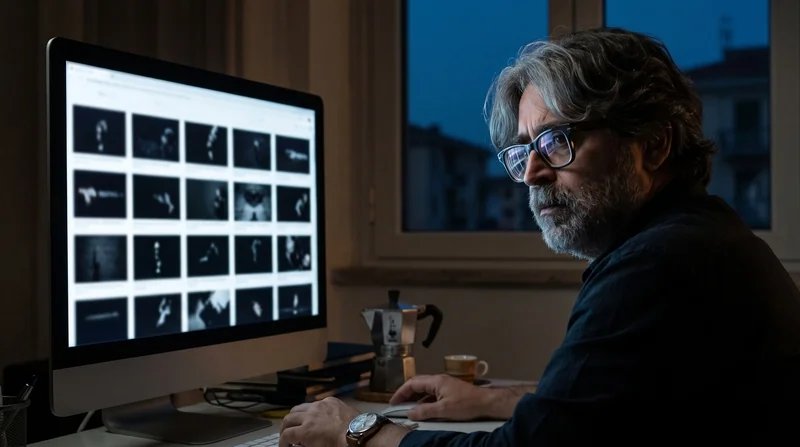
It's half six on a November morning and it's still dark outside. In the studio on via Melorio, in Santa Maria Capua Vetere, the moka pot has just stopped gurgling. The only light in the room is the cold glow of the monitor.
I open a stock image library and type two words: violence women.
The grid fills up in under a second. Black eyes, hands raised in front of faces, black backdrops. Twenty-year-olds with tidy hair and a tear caught in a side light straight off a film set. They're models. The bruise is make-up. The despair is a pose, built so the pain looks good on camera.
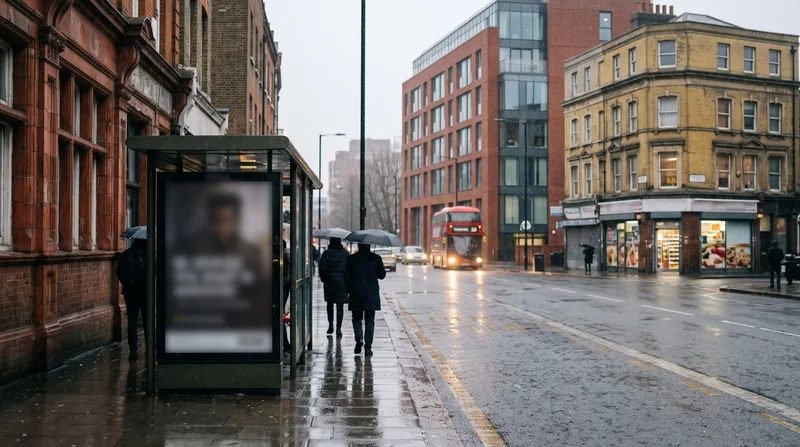
It takes me back to a bus stop on City Road, in London, outside the doors of Fergusson House. It was raining the way it rains there, fine and silent. On the shelter there was a poster against domestic violence. The language changed, the typeface changed. The picture didn't: the same bruise under the eye, the same downcast gaze.
I close the grid. I open another folder: the portraits I took in a refuge in Campania, during a project supporting the women who lived there.
Not one of them had a bruise on her face.
The mark was elsewhere. In the distance they kept from the lens. In the shyness. Almost in the fear of coming across as attractive, as if being beautiful were still a danger.
Then, in the later files, the sequence changes. The ice breaks, the smiles arrive. And with them comes something I can't describe any better than this: the pleasure of rediscovering themselves as simply beautiful.
The bruise is the easiest photo to take. That's exactly why it's the wrong one.
Why the bruise is the wrong photo
It only tells the last chapter
Zero Tolerance, a Scottish charity that has spent years working to prevent men's violence against women, asks journalists to stop using photos of battered women. The reason is simple: those images feed the idea that domestic abuse is only physical.
There's an old fable I've been using for a long time, and it even inspired one of my songs. Put a frog in a pan of lukewarm water and turn the heat on low. The frog adjusts, basks in the warmth, doesn't notice the temperature rising. By the time the water boils, it's too late to jump out.
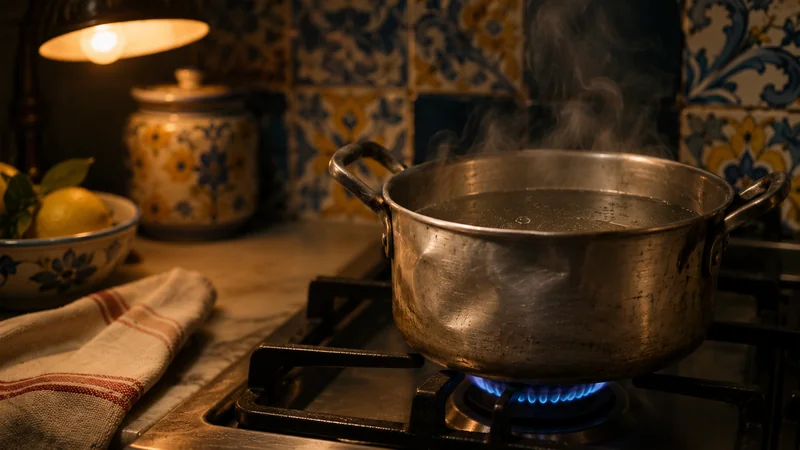
Violence in relationships often works like that. At first there's constant attention, messages, little kindnesses that feel like love. Then the first comment about how you dress. Then the doubts about your friends, the phone being checked, the bank account run by him. Your self-confidence crumbles bit by bit, without a single scratch.
Control leaves no bruises. And a photo hunting for the bruise will never see it.
Worse: to every woman still sitting in the lukewarm water, that photo says her problem isn't serious enough. Nobody's laid a finger on her yet, so it isn't violence. It's the most dangerous message a campaign can send.
This is where comparing Italy and the UK gets instructive. In England and Wales, coercive control has been a specific offence since 29 December 2015, under section 76 of the Serious Crime Act. Isolating someone, monitoring them, humiliating them, stripping away their independence: it's a crime even when there hasn't been a single slap.
In Italy, there's no offence by that name. Much of this behaviour is prosecuted as mistreatment of family members and cohabitants, under Article 572 of the Criminal Code. In 2024 the Court of Cassation, Italy's highest court, recognised economic abuse as mistreatment too. (I'm citing this as general context: it's no substitute for advice from a lawyer.)
And yet, in London as in Caserta, the bruise is still on the posters.
It leaves too much space between bodies
The second mistake is purely photographic, and I learnt it from a survivor I've never met. Taking part in the Scottish alternative-images project, she noticed that stock photos always leave too much distance between people. In real life, she said, an abusive partner is right on top of you.
It's a question of shot sizes and the distance between subjects, the same thing I tackled when writing about how much to include and how much to crop out of the frame.
In stock, the man is in the background, out of focus, two metres away, fist clenched towards the camera. The woman is in the foreground, isolated in the light. It's an advertising composition: it leaves room for the headline. But violence doesn't leave room. It pins you in the hallway, fills your field of vision, takes away your space.
It always has the same face
At the refuge I met mothers with small children, pregnant women, women who'd escaped trafficking. None of them looked like the young, thin, white, made-up model who fills the front pages of every image library.
When the only victim ever shown is the same one, all the others disappear. Older women, disabled women, migrant women. It's the same problem I faced photographing the over-60s with dignity and writing about photographing disability: whoever is never shown stops existing, even for the people who are supposed to help them.
Italy and the UK: two rulebooks, the same question
Working between the two countries, I often find myself comparing the rules. On images of violence, they exist on both sides of the Channel. The difference is who actually knows about them.
UK: charities write them, regulators adopt them
Level Up, a British feminist organisation, wrote the first guidelines on how the press should report deaths from domestic abuse. Both British press regulators, IPSO and IMPRESS, have adopted them.
On images, the guidance is clear-cut. No photos that sexualise the victim. No ‘happy couple’ holiday snaps when reporting a femicide, because they put the man who killed her at the centre. No stock imagery that reduces abuse to physical harm alone.
Alongside the rules there's a ready-made alternative: One Thousand Words, the photos produced for Scottish Women's Aid and Zero Tolerance and made available to newspapers.
Italy: clear rules, written for journalists
The Venice Manifesto, presented on 25 November 2017, commits those who sign it to take care over terms, content and images. It asks them to avoid stereotyped images that reduce women to sexual bait, and the misleading words attached to femicides: love, raptus (a sudden fit), madness, jealousy, passion.
Since 1 June 2025, the new Code of Conduct for Italian journalists has been in force. Article 13, which carries over the old Article 5-bis, asks them to:
- avoid gender stereotypes, and expressions and images that undermine dignity;
- never make victims identifiable, not even indirectly;
- stick to the essentials, without sensationalism;
- never blame the victim;
- respect the victim's family.
Article 20 adds that images that turn violence into a spectacle should be avoided.
For minors, the Treviso Charter (Carta di Treviso), now incorporated into the Code, applies: absolute anonymity, and nothing that could lead to identifying them, including the parents' names or the address.
On paper, then, Italy is crystal clear. The problem is whoever hits ‘publish’. The images for 25 November campaigns, corporate posts and conference flyers are almost never chosen by a journalist who's studied Article 13. They're chosen by a graphic designer with a six o'clock deadline, a social media manager with twenty minutes to close off the content calendar, a volunteer who searches ‘violence women’ and grabs the first photo that catches the eye.
The rule exists. The people who have to apply it often don't know it's there.
📦 Box 1 — The rules on images, Italy and the UK
| Criterion | United Kingdom | Italy |
|---|---|---|
| The bruise as a symbol | Level Up and Zero Tolerance guidelines ask for it to be avoided | The Venice Manifesto asks for stereotyped images to be avoided |
| Identifiability of the victim | Protection recommended by the guidelines | Art. 13 of the Code: prohibited, even indirectly |
| Sexualised body | To be avoided (Level Up) | To be avoided (Venice Manifesto, Art. 13) |
| ‘Happy couple’ photos | To be avoided: puts the perpetrator at the centre | No specific guidance |
| Minors | Identity protected | Treviso Charter: absolute anonymity |
| Coercive control | Specific offence since 2015 | Treated as mistreatment (Art. 572, Criminal Code) |
The masters: who paved the way, and who got it wrong
Before picking up a camera on a subject like this, you need to study the people who've tried before. Not to copy their style, but to understand where the line runs between bearing witness and exploitation.
Donna Ferrato: ten years inside people's homes
For a decade Donna Ferrato criss-crossed the United States photographing domestic violence. She rode in police cars, slept in shelters, stayed as a guest in the homes of abused women. The result was Living with the Enemy, published by Aperture in 1991.
The lesson. She shot only black-and-white film, to strip the spectacle of colour away from the pain. An ethical choice before an aesthetic one.
The limit. Many of the photos show violence as it happens, sometimes in front of children. Today the question is unavoidable: is a woman being attacked in her own home in any position to say no to the person photographing her?
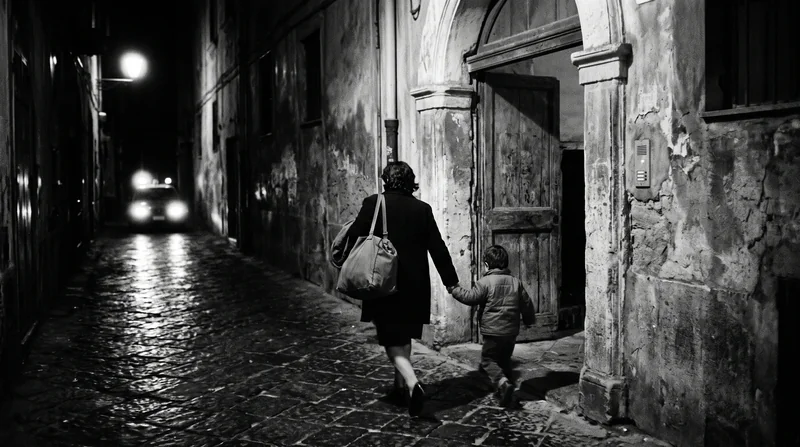 Image inspired by ‘Living with the Enemy’ by Donna Ferrato. Set in Naples.
Nan Goldin: the image is hers
Nan One Month After Being Battered, 1984. Goldin portrays herself a month after her partner had beaten her and nearly blinded her. She herself called it the central image of The Ballad of Sexual Dependency.
The lesson. A friend physically pressed the shutter, but Goldin had composed the frame. She looks straight into the lens, lipstick immaculate, no plea for pity. She doesn't present herself as a victim: she presents herself as a woman documenting her own life.
The limit (and this is my own opinion). The stock industry copied the surface of that photo, the marked face looking into the camera, and threw away the only thing that mattered: she was the one deciding.
 Image inspired by ‘Nan One Month After Being Battered’ by Nan Goldin. Set in London. The tribute doesn't reproduce the injuries: it takes up her lesson, that she's the one who decides the image.
Rankin and Women's Aid: the most-seen campaign, the most misguided symbol
In 2007 the agency Grey London created the What's it going to take? campaign for Women's Aid. Rankin photographed nine famous women, actresses and presenters among them, made up with bruises and split lips.
The lesson. In media terms it was a hit: everyone worked for free and the coverage was estimated at around £30 million. One of the posters admitted as much itself: a celebrity with fake bruises might look like a cheap trick, but at least you noticed her.
The limit. Even at the time, some British journalists found the images striking but odd, and wondered what they were really meant to say. I think they turned the made-up bruise into the visual code for domestic abuse for years. They taught a whole generation of creatives that a good make-up artist is all you need to talk about abuse.
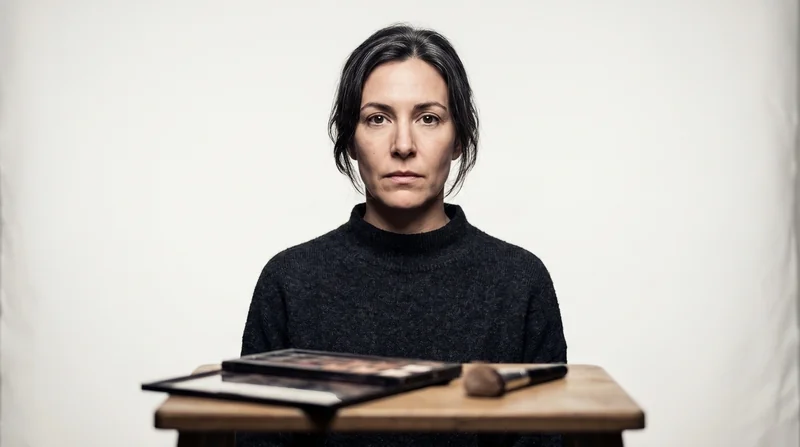 Image inspired by ‘What's it going to take?’ by Rankin for Women's Aid. Set in a studio in Hackney, London. The tribute flips the campaign on its head: the make-up stays shut.
Laura Dodsworth: the alternative that works
For One Thousand Words Laura Dodsworth created fifteen photographs with models, starting from the words and experiences of women who had survived abuse. No bruises, no physical violence. The images are free for newspapers to use with a copyright credit, and today they're widely used by the media and in UK government publications.
The lesson. They shift the gaze from the injured body to the experience.
The limit. They're still openly staged. They work for illustration, not for documentation.
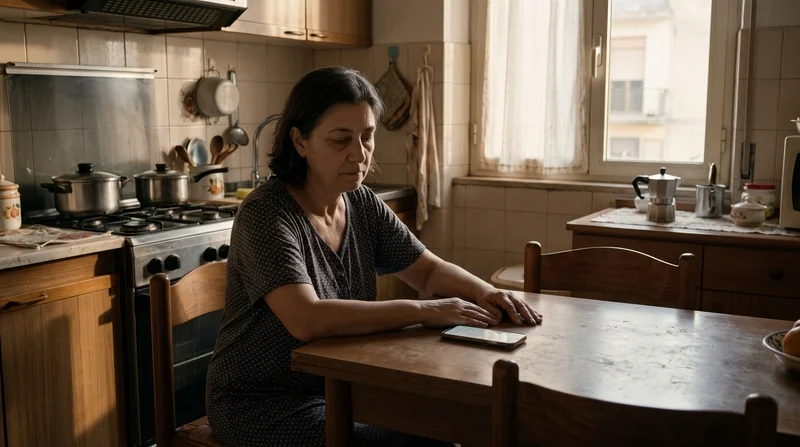 Image inspired by Laura Dodsworth's ‘One Thousand Words’ project. Set in Caserta: control, told without a single bruise.
Stefania Prandi: photographing those left behind
For three years Stefania Prandi met the families of women killed in Italy. She gathered portraits, and images of objects and places. The result was Le conseguenze. I femminicidi e lo sguardo di chi resta (‘The Consequences: Femicides and the Gaze of Those Left Behind’, Settenove, 2020).
The lesson. Distance kept out of respect for the people photographed. No stolen tears: the emptiness and the things left behind do the talking.
The limit. It tells the story of the aftermath. That's necessary, but it comes when it's already too late. Anyone communicating for prevention has to find a way to tell the before.
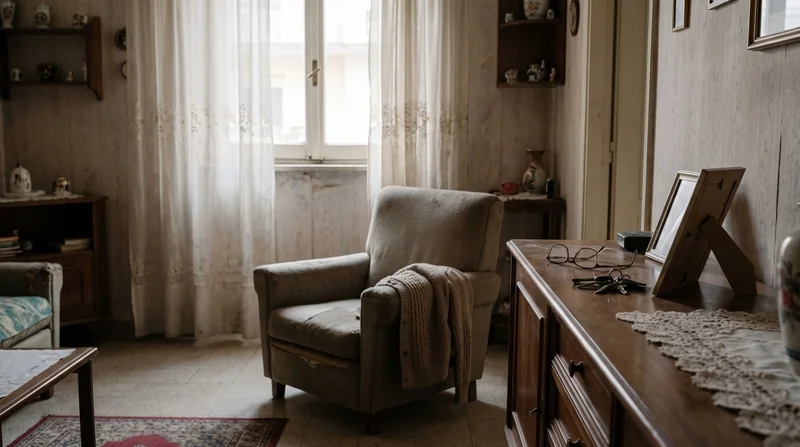 Image inspired by ‘Le conseguenze’ by Stefania Prandi. Set in Portici.
Letizia Battaglia: dignity before the news
Letizia Battaglia didn't work specifically on domestic violence. But her way of looking at the women and girls of Palermo is still a compass: she searched for dignity where others saw only the margins. Years after taking La bambina con il pallone (‘The Girl with the Ball’, La Cala district, Palermo, 1980), she went looking for the girl to find out who she'd become.
The lesson. The subject doesn't end when the shot does.
The limit. Her photos of Mafia killings show bodies that couldn't give any consent. They were necessary in 1980s Palermo. In social-cause communication today they'd be something else entirely.
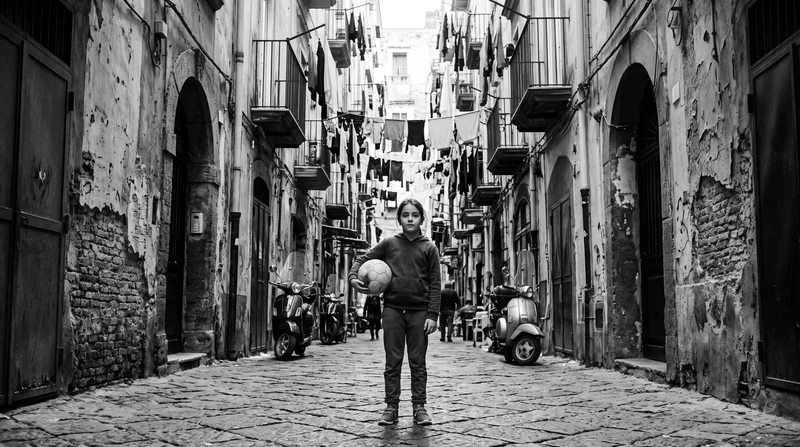 Image inspired by ‘La bambina con il pallone’ by Letizia Battaglia. Set in the Quartieri Spagnoli, Naples. The girl pictured doesn't exist.
aleXsandro Palombo: the Italian counter-example
The artist digitally retouched photos of celebrities such as Kim Kardashian and Emma Watson to make them look beaten, without their consent.
The lesson in reverse. A just cause doesn't give you licence to use a woman's face. Using that face without permission, even to denounce violence, is still an abuse of power.
Inside a refuge in Campania: the portraits I never published
Everything you read in books has to reckon with reality once you walk into a protected space. That's why I won't name the town, I won't describe the building and I won't give any details about the residents or their children.
The project
The refuge takes in women, mothers and pregnant women who are victims of violence and trafficking, along with their children. The project was there to raise funds for activities supporting them.
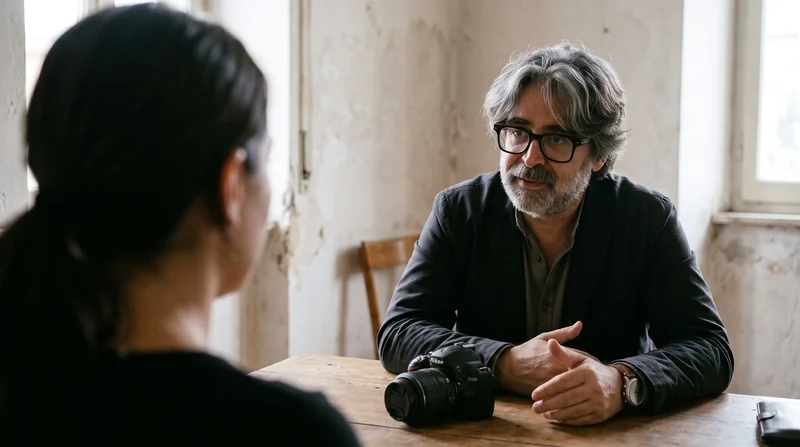
I wrote the scripts for and directed a series of short parenting-support videos. And while I was there I took loads of portraits of the residents. As I always do on mixed photo-and-video jobs, I had two bodies with me: the Panasonic Lumix G90 for video and the Nikon D3200 for stills.
Before: the distance
Gestures and glances spoke of a thousand emotions. At first there was wariness and shyness. They kept their distance, almost afraid of being attractive. It's hard to put into words, but in front of a lens you see it with a clarity that knocks you sideways.
It's a moment you can't force. Trust, like a ragù, needs hours on a low heat. It's the same low heat as the frog's pan, with the opposite result: there, the heat cooks you without you noticing; here, it warms you until you're the one who chooses to come closer.
The rule, in a space like that, is not to shoot until you've been accepted. The photographer, like the postman, should always ring twice. Maybe a hundred times.
Then: the ice broken
Once they started to feel at ease, the strength of their smiles came through. And so did the pleasure of rediscovering themselves as simply beautiful, in those shots.
That's when I understood what the work was really for. The opposite of a bruise isn't an empty image. It's a woman who looks at herself and likes what she sees.
The choice: not to publish
Those portraits have never been published. They didn't go online or into the project materials. They were only displayed inside the refuge, in the private areas, not in the ones open to the public.
It's the most radical lesson I carry with me. Sometimes the right destination for a portrait isn't the public, or the client, or a feed. It's the person in it. Photography as giving back, not as content.
It's Nan Goldin's lesson taken one step further: the image belongs to the woman portrayed, even when she isn't the one holding the camera.
A published face doesn't come back
For a woman who's escaped trafficking, a face online isn't a privacy issue. It can become an address for whoever is looking for her.
There's a story from my part of the world that says it better than any rule. Teresa Buonocore was a woman from Portici. On 20 September 2010 she was killed in Naples, on via Ponte dei Francesi, because she had testified against the man who had abused her daughter. To recognise her, the killers had printed out a photo of her taken from her daughter's Facebook profile.
The blame lies solely with the people who killed her. But that photo reminds us of something nobody who communicates can afford to forget: an image, once published, goes on a journey nobody controls any more.
The children
For minors there's only one rule: no recognisable children. The Treviso Charter demands it, and common sense demands it first.
In the videos, the relationship between mother and child is told through hands, gestures of care, objects. Never through faces.
💡 Box — Before shooting in a protected setting
- Who authorises: the management of the facility, the adult being photographed, whoever holds parental responsibility for any minors. Always in writing.
- Where the photos will go: decide this beforehand. Internal use, private prints, a campaign, the web: they're all different kinds of consent.
- Who can withdraw consent: the person photographed, at any time, without having to explain why.
- Faces or no faces: with trafficking victims or minors, the starting answer is no.
- GPS location: switched off on cameras and phones before you even arrive.
- Copies: to the women photographed, first and foremost.
What to photograph instead of the bruise: set-up and settings
If we take the bruise away, what do we put in front of the lens? Six solutions, with the settings I use on my own kit: the Lumix G90 with the 12-60 mm f/3.5-5.6 (Micro Four Thirds, 2× crop factor) and the Nikon D3200 with the 18-55 mm and the 55-200 mm (APS-C, 1.5× crop factor).
The giving-back portrait
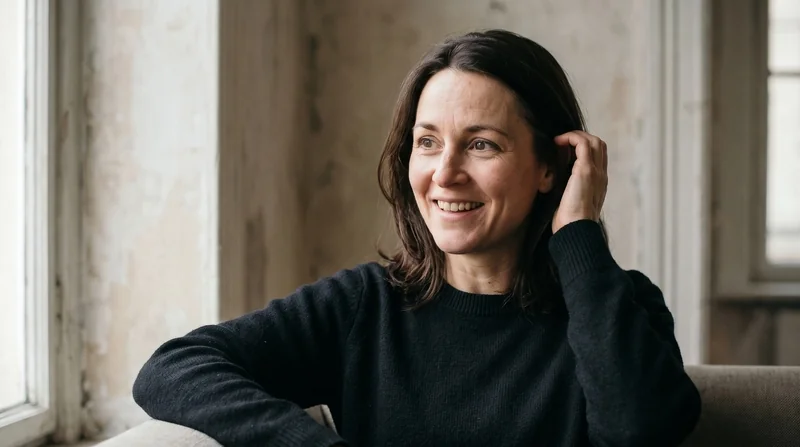
When a woman agrees to be photographed for herself, the light should caress, not interrogate. No direct flash. A side window, the subject about a metre from the glass, a white reflector on the opposite side to open up the shadows without flattening the face.
I work with a short telephoto. On the D3200, the 55-200 between 60 and 90 mm (90-135 mm equivalent), at f/5-5.6, which at those focal lengths is pretty much wide open. Indoors with window light you need ISO 800-1600 to stay around 1/160 s. Single-shot focus on the nearer eye.
The telephoto isn't just there to compress the planes of the face. It's there to respect the distance: she decides how close to come.
In post-production the retouching is minimal. No plastic skin, no wrinkles wiped away. She has to recognise herself.
Objects: the still life of the aftermath
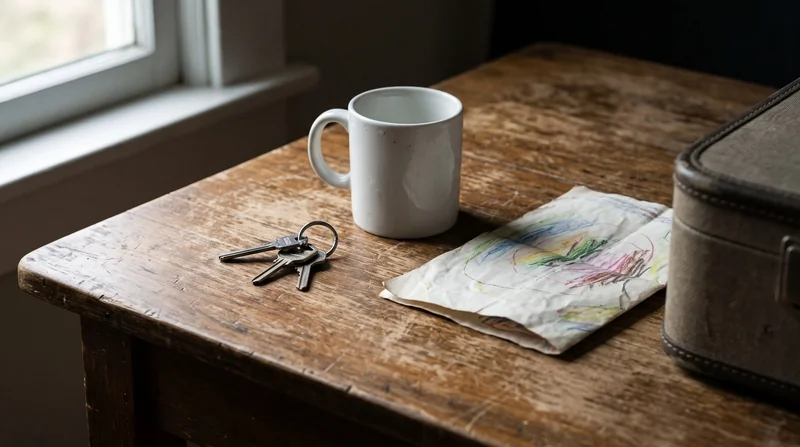
A bunch of keys next to a mug. A baby's bottle on the windowsill. A child's drawing next to a closed suitcase. An everyday object tells of an escape, a wait or a fresh start better than a face can.
Side window again, but this time with a black panel on the shadow side to deepen the shadows and give volume. Lumix G90 on a tripod, the 12-60 between 35 and 45 mm (70-90 mm equivalent), f/5.6, which at that focal length is wide open. On Micro Four Thirds, f/5.6 gives a depth of field similar to f/11 on full frame: perfect for reading textures. ISO 200, 2-second self-timer, RAW.
The mistake to avoid is warm, dramatic light that turns pain into atmosphere. That's fine for intimacy by candlelight, not here. For handling the light, have a look at my tips on still life lighting.
Places: absence as the subject
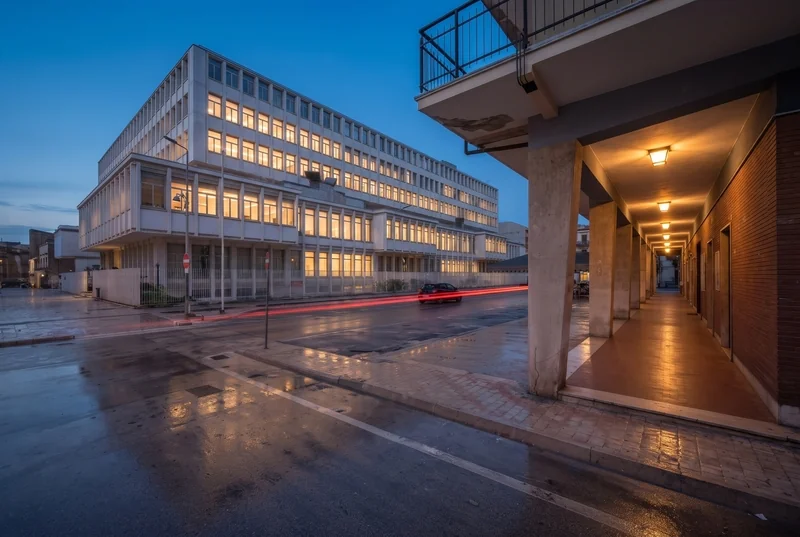
Telling the story of violence also means photographing the places where it's decided whether to protect a woman or leave her on her own. I'm thinking of the portico of the Criminal Court in Santa Maria Capua Vetere, on via Giuseppe Bonaparte. Pale stone columns, the red-brick building on one side, the white court building across the road.
It's an image that ties in with the theme the United Nations chose this year for the 16 Days of Activism against Gender-Based Violence: ensuring justice, protecting survivors, ending impunity.
I shoot it at blue hour, which in late November falls around 5pm, when the light in the sky balances out with the lighting under the portico. G90 on a tripod, 12 mm (24 mm equivalent), f/8, ISO 200, long exposure. For the technical details, have a look at how to photograph when it's already dark by 5pm and at handling artificial light.
There's a line you don't cross. I've written about photographing places of memory, but there the place is a monument. Here it never is. A victim's home, her family's street, the outside of a refuge are never photographed in a way that makes them recognisable. The public architecture of a courthouse speaks of the State's responsibility. The front of a house exposes real people.
Campaigning environmental photography follows the same rule: show the problem without exposing the people living through it.
Hands and gestures
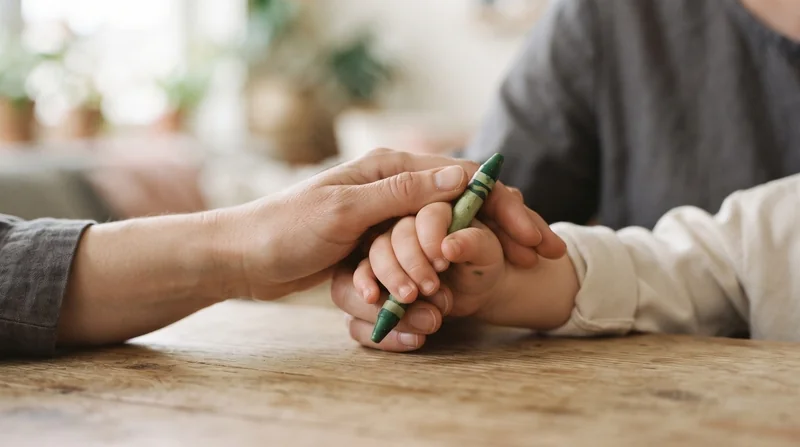
A mother's hand over her child's. Two hands close together on a table, closer than would be comfortable. Fingers gripping a bunch of keys.
I work from a distance so as not to interfere with the gesture. D3200 with the 55-200 at around 135 mm, f/5.6, at least 1/250 s to freeze children's movements. Indoors you need ISO 800-1600. Outdoors, 200-400 will do. I've explained elsewhere why hands deserve a frame of their own.
The faceless portrait: backlight
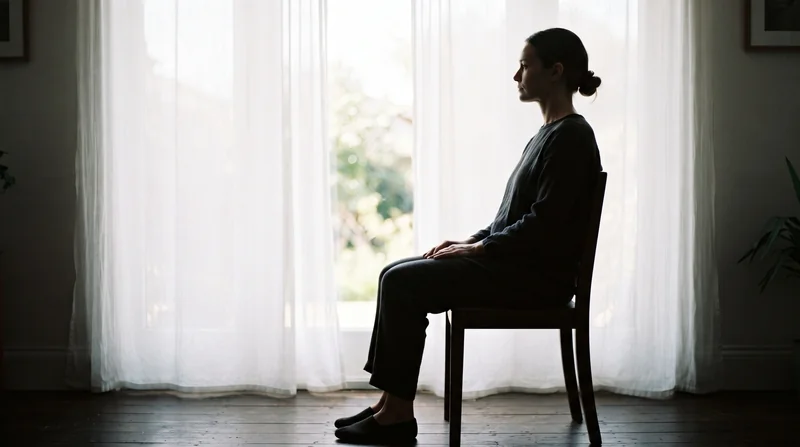
Sometimes a woman wants to be there with her own body, but needs to protect her identity. Backlighting against a bright window works, as long as you don't fall into the naive mistakes.
Spot metering on the window. The face drops 2-3 stops. G90 with the 12-60 between 12 and 20 mm, at f/3.5-4 (wide open at those focal lengths), ISO 400-800. I check the histogram: the shadows have to stay blocked up, because lifting them in post would bring the features back into the light. The techniques are the ones for silhouettes and creative backlighting.
Careful, though: blurred doesn't mean anonymous. A tattoo on the wrist, a distinctive ring, a plait, a scar are enough for someone who knows her to recognise her. Before signing off a backlit shot or one from behind, I zoom in to 100% and check every detail.
Black and white, for the right reason
Converting to black and white isn't about adding drama. It's about taking it away, as Ferrato did: strip out the noise of colour and what's left is the light on the people.
In Lightroom I do a gentle conversion, medium contrast. No dark vignette round the edges, which instantly smacks of cheap photo-romance. No fake grain. The method is the one from thinking in black and white, and for processing, have a look at Lightroom and Camera Raw.
Metadata: the safety you can't see
Smartphones, and cameras paired with a phone, can record the exact GPS location of the shot in the file, along with the date, time and serial number. A photo taken outside a safe house, with location switched on, carries the address with it.
In Lightroom Classic, when exporting, in the Metadata section I choose to include copyright only and tick the option to remove location info. To make sure nothing's been left behind, I run this in the terminal:
exiftool -all= filename.jpg
On my Samsung Galaxy S21 I switch off the camera setting that adds location to photos before I even open the app.
🎯 Box 3 — Alternatives to the bruise, at a glance
| Alternative | Light and set-up | Settings |
|---|---|---|
| Giving-back portrait | Side window, white reflector | D3200, 90-135 mm eq., f/5-5.6, 1/160 s, ISO 800-1600 |
| Still life of objects | Side window, black panel, tripod | G90, 70-90 mm eq., f/5.6, ISO 200, 2 s self-timer |
| Public places | Blue hour, mixed light, tripod | G90, 24 mm eq., f/8, ISO 200, long exposure |
| Hands and gestures | Natural light, shot from a distance | D3200, 200 mm eq., f/5.6, 1/250 s or faster |
| Faceless backlight | Very bright window | G90, 24-40 mm eq., f/3.5-4, spot on the window, face -2/-3 stops |
| Black and white | Any consistent natural light | Gentle conversion, no vignetting, no grain |
Stock, AI and deepfakes: the red line
These days, whoever's putting a campaign together doesn't just dip into stock any more. They open an image generator and ask for the battered face of a woman who doesn't exist, convinced they've solved the consent problem.
They've made it worse. The generators were trained on those same libraries, and they churn out the same young, white, made-up faces. I've written about how artificial intelligence has rewritten stock photography: on this subject it multiplies the cliché endlessly. And a synthetic image passed off as real destroys the reader's trust, as I explained when talking about what to declare when you use AI in Italy and the UK.
Before signing off an image on this subject, I always run the six-no test:
- No to bruises, real or made-up.
- No to the sexualised body, to vulnerability struck as a pose.
- No to the happy couple when the story is about abuse or femicide.
- No to a single face: only young, white women.
- No to a real face without consent, in writing and revocable.
- No to undeclared AI in the caption.
Then there's the legal red line. In Italy, Article 612-quater of the Criminal Code, introduced by Law No. 132 of 2025, punishes with one to five years' imprisonment anyone who, without consent and causing unjust harm, distributes content generated or altered with artificial intelligence that's capable of misleading people about its authenticity.
In the UK, since 6 February 2026, section 138 of the Data (Use and Access) Act 2025 makes it an offence to create, or request the creation of, intimate images of an adult without their consent, including those fabricated with deepfakes. (Again: this is for information, not legal advice.)
✅ Box 2 — Checklist before you publish
- Source: do you know who took the photo and in what context?
- Consent: is there a release specific to this channel, signed without pressure?
- Safety: does the photo leave out addresses, neighbourhoods, schools, shelters?
- Metadata: have you stripped the EXIF data and GPS location?
- Six-no test: passed on every point?
- Transparency: if it's illustrative, uses models or was generated with AI, does the caption say so?
Captions and alt text for images about violence
A respectful photo can be ruined in three seconds by the wrong caption. I said as much when reading The Aftermath: the caption shouldn't do the emotional work that belongs to the photo.
Take a sober photo: a bunch of keys on a wooden table, next to a mug.
| ❌ Wrong caption | ✅ Right caption |
|---|---|
| ‘A woman's despair, victim of her partner's fury’ | ‘House keys on the table. Illustrative image made with the consent of the person pictured.’ |
The first puts all the melodrama you'd taken out straight back into the frame. And ‘fury’ is a close cousin of that raptus the Venice Manifesto asks us not to use, along with love, madness, jealousy and passion. Violence isn't a sudden impulse. It's a choice to dominate.
Then there's the alt text, the text that describes the image to people using a screen reader and to search engines. The same principle applies: describe what you can see, without interpretation. Not ‘Woman broken by grief leaves her violent husband's home’, but ‘A bunch of keys on a wooden table, next to a ceramic mug, side light from a window’. Someone listening to the description deserves the same respect as someone looking. It's something I've covered when talking about web accessibility.
The most important photo is the one you'll never see
Outside, the grey morning light is starting to creep in between the buildings on via Melorio. The grid of black eyes has been closed since the start of this article, and that's where it stays.
The portraits from the refuge are among the most important photos I've ever taken, and nobody will ever see them online. That's as it should be. Their job wasn't to bring traffic to a website, but to stay where they are: close to the women who, looking at themselves, began to recognise themselves again.
The same theme follows me outside photography too. With SloU Cobra, my music project, I wrote Lacrime di fuoco (‘Tears of Fire’), on the 2024 album Anime, my first work in Italian. Then Nel nome delle madri (‘In the Name of the Mothers’), a single from May 2025, born from the story of Teresa Buonocore and all the mothers who died defending their children from abuse. And today Bollore Lento (‘Slow Boil’) went out for distribution: the frog in the pan, love that turns into control one degree at a time. The tracks are on SloU Cobra's YouTube Music channel.
The bruise is the easiest photo to take and to buy. That's exactly why it's the wrong one. It reduces women to passive victims, hides the control that comes before the beatings and turns real pain into a cliché that no longer moves anyone.
If you work for a charity, a refuge, a public body or a company that wants to communicate on this subject, go back over your images today with this article's checklist. And if you want to build a respectful visual story, or a programme of giving-back portraits within your organisation, at EmmeU Creative Studio we start where we always start: by listening.
📞 Useful numbers
- Italy — 1522. Free public helpline run by the Department for Equal Opportunities (Dipartimento per le Pari Opportunità), open 24 hours a day, every day. There's also a chat on the 1522.eu website.
- United Kingdom — 0808 2000 247. National Domestic Abuse Helpline, run by Refuge, free and open 24 hours a day.
Sources
The sources for the data, laws and cases cited in the article, in the order they appear. The legal information is general context and is no substitute for advice from a lawyer.
- Stock images of violence
- The distance between bodies in stock photos Testimony from a survivor who took part in the project.
- Coercive control in the UK In force since 29 December 2015.
- Mistreatment in Italy
- The British guidelines
- The Venice Manifesto
- The Code of Conduct, Articles 13 and 20 In force since 1 June 2025.
- The Treviso Charter
- Donna Ferrato
- Nan Goldin A friend pressed the shutter; Goldin composed the frame.
- Rankin and Women's Aid
- Stefania Prandi
- Letizia Battaglia
- aleXsandro Palombo
- Teresa Buonocore One secondary source dates the murder to 2009: Il Post and the Polizia di Stato confirm 20 September 2010.
- The 2026 UN theme
- The deepfake offence in Italy
- The deepfake offence in the UK Section 138 of the Data (Use and Access) Act 2025, in force since 6 February 2026.
- Useful numbers
Frequently asked questions
Why not use photos of bruises to talk about violence against women?
Because they only show physical violence, the most visible part and often the last. Control, isolation and economic abuse leave no marks, and the women living through them don't recognise themselves in those images. On top of that, they're almost always staged with made-up models.
What's the difference between an illustrative image and documentary photography?
An illustrative image is constructed, with models, objects or a set, to represent a subject. Documentary photography records real people and real events. Both are legitimate, but the caption should always say which one it is.
How do you photograph a survivor without making her recognisable?
With backlighting, shots of hands and gestures, shots from behind. Before publishing, check every detail at 100%: a tattoo, a ring or a hairstyle is enough to identify someone. And strip the GPS data from the file.
Can I use artificial intelligence to illustrate an article on gender-based violence?
You can, but it has to be declared in the caption, and you shouldn't generate battered faces or images of real people. Generators reproduce the same stereotypes as the libraries they were trained on. In Italy, Article 612-quater of the Criminal Code punishes the harmful distribution of AI-altered content.
How do you remove the GPS location from a photo before publishing it?
In Lightroom Classic, when exporting, include only the copyright metadata and remove the location info. From the terminal, the command exiftool -all= filename.jpg wipes all the metadata. On a smartphone, it's worth switching off location tagging in the camera.
What rules apply in Italy to images of gender-based violence?
For anyone working in news, the Venice Manifesto and the Code of Conduct in force since 1 June 2025: Article 13 prohibits making victims identifiable, even indirectly, and Article 20 asks for images that turn violence into a spectacle to be avoided. For minors, the Treviso Charter applies.
When is it better not to publish a photo at all?
When the person pictured could be put in danger, as with a trafficking victim, when there are recognisable children, or when consent isn't full and revocable. Sometimes the right destination for a portrait is simply the person in it.
About the author

By accepting you will be accessing a service provided by a third-party external to https://insightadv.it/
































































Comments